Number puzzle guide
How to Make 24 From Four Numbers: A Practical 24 Game Strategy
The 24 game gives you four numbers and one job: combine them with addition, subtraction, multiplication, and division so the result is exactly 24. Some hands fall in seconds; others look impossible until you see a fraction hiding in them. This guide shows the patterns strong players look for, how to work backward from 24, and how to crack the handful of hands that need fractions.
The rules, and how Fourfold 24 plays them
In the standard version you get four numbers, usually from 1 to 9, and must use each one exactly once. You may use the four basic operations and any grouping you like. You cannot glue digits together, so a 1 and a 2 cannot become 12.
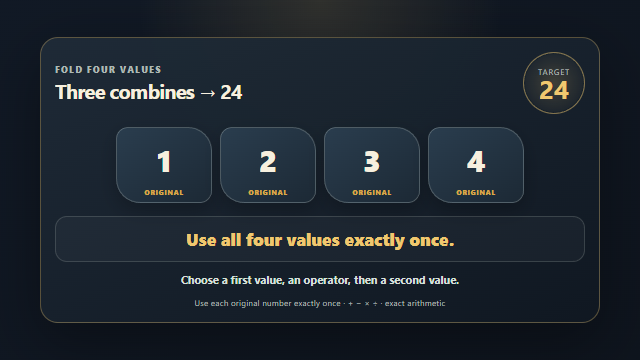
Fourfold 24, the BeanNest version, turns that into a tile game. You pick two tiles and an operator, they merge into one tile showing the result, and you repeat. Four tiles become three, then two, then one, so every solve is exactly three combines. Zero, negative, and fractional intermediate results are all legal and are shown as exact fractions, never rounded decimals. The order you pick tiles in sets the direction for subtraction and division, so 8 then 2 with the divide operator gives 4, while 2 then 8 gives 1/4.
Thinking in combines is a good habit even on paper. Every solution, however it is written, is a sequence of three pairings. Asking which pair to merge first is a far smaller question than staring at all four numbers at once.
Start with the factor targets
The fastest way to find a solution is to know what the last step usually looks like. Most solutions finish with a multiplication of two factors of 24. Memorize the pairs: 1 x 24, 2 x 12, 3 x 8, and 4 x 6. When you look at a hand, ask whether one number can be set aside as a factor while the other three make its partner.
Take 3, 4, 7, 9. If 3 is the factor, the other three must make 8. Nine minus 7 is 2, and 2 times 4 is 8, so the solution is (9 - 7) x 4 x 3. Or take 1, 2, 3, 4: you can simply multiply all four. A 1 in a hand is almost free, because multiplying or dividing by 1 changes nothing, so a hand with a 1 really asks you to make 24 from three numbers.
Addition finishes are worth scanning too: 12 + 12, 20 + 4, 18 + 6, 16 + 8, and 15 + 9. Hands with several large numbers often finish this way.
Subtraction and division finishes
When no factor pair appears, look for a slightly larger number you can trim. The common subtraction finishes are 25 - 1, 27 - 3, 28 - 4, 30 - 6, 32 - 8, and 36 - 12. For 2, 3, 5, 6: multiply 5 x 6 to get 30, multiply 3 x 2 to get 6, then subtract. That is three combines, each number used once.
Division finishes cover the hands with big products: 48 / 2, 72 / 3, and 96 / 4. For 6, 7, 8, 9, multiplying 6 x 8 gives 48, and 9 - 7 gives the 2 you need to halve it. When you see two numbers whose product is 48 or 72, check whether the remaining pair can make 2 or 3.
- Product finishes: 3 x 8, 4 x 6, 2 x 12, 1 x 24.
- Sum finishes: 12 + 12, 16 + 8, 18 + 6, 20 + 4, 15 + 9.
- Difference finishes: 25 - 1, 27 - 3, 28 - 4, 30 - 6, 32 - 8, 36 - 12.
- Quotient finishes: 48 / 2, 72 / 3, 96 / 4.
Work backward from 24
Working forward means trying combinations and hoping one lands on 24. Working backward means choosing a last step and asking whether it is reachable. Backward is usually faster because the list of useful last steps is short.
Here is the method as a routine. For each number in the hand, imagine it is used in the final combine. Ask what the other three would need to make: if 8 is last and multiplied, they must make 3; if 8 is last and added, they must make 16; if 8 is last and subtracted from something, they must make 32. Three numbers making a small target is a much easier puzzle, and you can check it quickly.
Also try splitting the hand into two pairs. With 2, 3, 5, 6 the split (5, 6) and (2, 3) gives 30 and 6, which subtract to 24. With 1, 2, 7, 7 the split (7, 7) and (1, 2) is less obvious, but 7 x 7 is 49, 49 - 1 is 48, and 48 / 2 is 24. Pair splits are worth checking whenever a single-factor approach stalls.
Fraction tricks for the hardest hands
A few hands cannot be solved with whole numbers at every step. If you count every unordered hand drawn from the digits 1 to 9, there are 495 of them; 404 can make 24 with the four operations, and exactly seven of those require a fraction along the way. They are 1 3 4 6, 1 4 5 6, 1 5 5 5, 1 6 6 8, 3 3 7 7, 3 3 8 8, and 4 4 7 7.
They follow two patterns. The first is dividing by a small fraction. Since 24 divided by 1/4 is 96 and 6 divided by 1/4 is 24, any hand that can produce 1/4 next to a 6 is solved. For 1, 3, 4, 6: 3 / 4 is 3/4, 1 - 3/4 is 1/4, and 6 / (1/4) is 24. For 3, 3, 8, 8: 8 / 3 is 8/3, 3 - 8/3 is 1/3, and 8 / (1/3) is 24.
The second pattern is building a fraction that a final multiplication cancels. For 1, 5, 5, 5: 1 / 5 is 1/5, 5 - 1/5 is 24/5, and 24/5 x 5 is 24. For 4, 4, 7, 7: 4 / 7 is 4/7, 4 - 4/7 is 24/7, and 24/7 x 7 is 24. In both cases you are making 24 divided by some number, then multiplying that number back.
The clue that a hand needs this trick is repeated numbers that refuse to combine into factors of 24. When you see a pair like 7, 7 or 5, 5, 5, try dividing one copy into another number, subtracting, and multiplying by the last copy.
A practice routine that builds speed
Speed in the 24 game comes from recognizing shapes, not from faster arithmetic. A short, regular routine is more useful than long sessions.
- Scan for a 1 first. It usually means you only need three numbers.
- Check the four factor pairs, setting each number aside in turn as the factor.
- Try the two-pair split: three possible ways to divide four numbers into two pairs.
- Look for a product of 48 or 72 that a remaining 2 or 3 can divide.
- If repeated numbers resist every approach, try the fraction patterns.
- After solving, look for a second solution. Hands with two routes teach you to see both.
Play Fourfold 24
Fourfold 24 is a free browser version with two modes. Daily serves a Quartet of four puzzles that steps up in difficulty, and every Daily hand has at least one whole-number solution, so the fraction-only hands never block your streak. Practice lets you choose a difficulty band from Starter through Expert and replay without a countdown; the seven fraction hands live in Expert.
If you get stuck, Undo and Reset are unlimited, and three hint levels go from a gentle nudge, to the first step, to the full remaining route. Using a hint marks that puzzle as assisted, which is a nice way to keep yourself honest while you learn the patterns above.
Frequently asked questions
Is every set of four numbers solvable?
No. Of the 495 unordered hands using digits 1 to 9, 91 cannot make 24 with the four basic operations. A simple example is 1, 1, 1, 1. Fourfold 24 only serves hands that have at least one solution.
Can I use exponents, square roots, or join digits?
Not in the standard game, and not in Fourfold 24. You have addition, subtraction, multiplication, and division, and each number is used exactly once.
Are negative numbers allowed along the way?
Yes. In Fourfold 24, zero, negative, and fractional intermediate values are all legal, as long as the final tile equals exactly 24.
What is the hardest 24 game hand?
Players disagree, but the fraction-only hands such as 3, 3, 8, 8 and 1, 5, 5, 5 are common nominations because no whole-number route exists.